Environment cannot be saved without saving people:Joshi
3 min read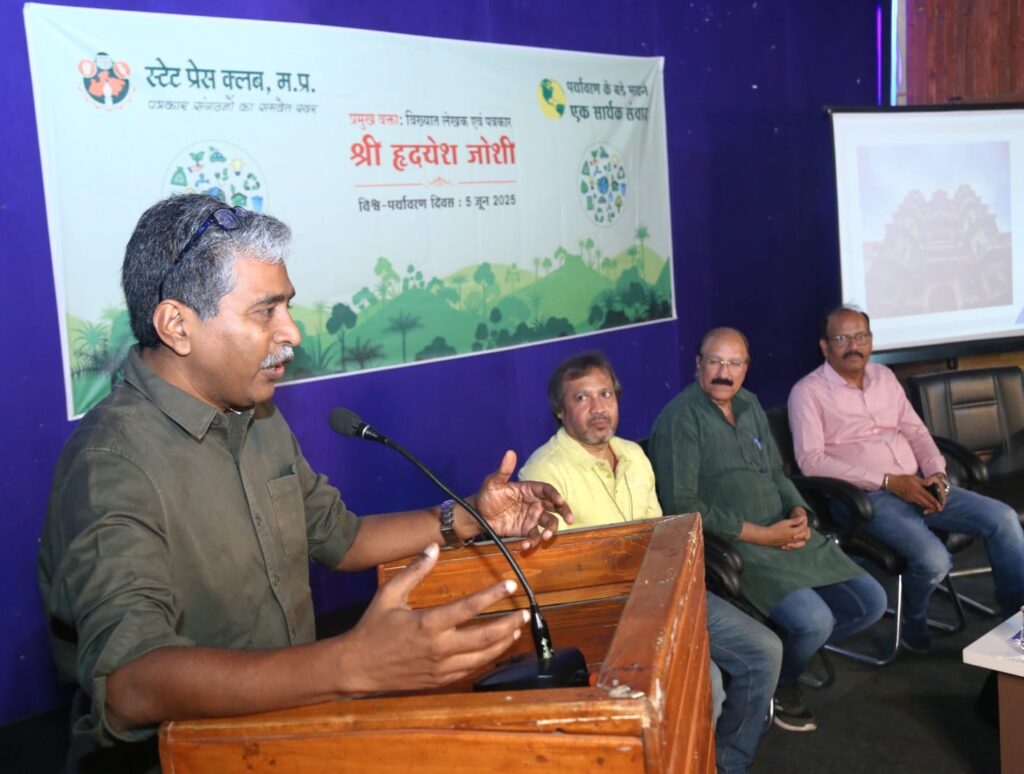
State Press Club(MP) hosts dialogue program on World Environment Day
Indore(Team Newsbuddy): If you talk about saving the environment, you also save the economy. If people are saved, then only the forests will be saved and if forests are saved, then the lions will also be saved, this is the cycle and rule of nature. Today, India’s population is as big as the world’s population was 125 years ago. Approximately 140 crores. Now there is seven to eight times more load on the earth. The biggest concern is not the population, but the changing lifestyle.
This view was expressed by famous writer, researcher and journalist Hridayesh Joshi in the dialogue program of State Press Club, MP on the occasion of World Environment Day. Mr. Joshi said that today’s modern lifestyle includes digital lifestyle, luxury lifestyle, ways of traveling, eating and living habits and comforts. We are increasing energy wastage with every hand, with every thing. For example, electric cars and two-wheelers, which we consider green vehicles, but the electricity used for recharging them is produced by burning coal. Or electricity is being produced from generator sets. So, the matter comes back to the same. For green energy, it is necessary that the method of producing electricity should also be green.
He said that even though rivers originate from glaciers, they get their strength from forests. Ramganga river originating from Dudhtauli village originates from forests. Forests collect water streams and release water slowly. The same story is with Narmadaji originating from Amarkantak in Madhya Pradesh. It gets water from forests. Many small rivers join the river. We have to save rivers from pollution. And what will be the benefit of building bumper to bumper dams?
Shri Joshi said that we should conserve the ponds, lakes, rivers and water sources around us. Wetlands are very important. How migratory birds come to Bharatpur, Rajasthan. The same scene can be seen in Sirpur lake of Indore. But we consider wetlands as wastelands, meaning useless. Deserts, grasslands, wetlands, mountains are all part of the ecosystem and they have their own important role in the environment.
Through an extended presentation, Shri Joshi gave information with examples about education, health, economy, infrastructure, lifestyle, agriculture and the coming future. Regarding the increasing vehicles and pollution, he said that mass rapid transport is the only solution. We have seen that, there is a crowd of cars in cities and tourist places. Nowadays people take their own cars from one place to another. Think how many carbon footprints it has. It is not that people will not use public transport. We have to provide last mile connectivity. The way people are using the metro with ease and simplicity in cities like Delhi, this is the transport of the future.
In the dialogue program, Kumar Siddharth, Dr. Jayshree Sikka, Sanjay Patel, Rajendra Kopargaonkar, Rakesh Dwivedi, Abhishek Singh Sisodia, Deepak Maheshwari and Rajdeep Malhotra asked questions on contemporary issues. At the beginning of the dialogue program, Hridayesh Joshi was welcomed by senior environmentalist OP Joshi, Dilip Vaghela, State Press Club, M.P. President Praveen Khariwal, Seva Surbhi coordinator Om Nareda Kumar Siddharth, Rameshwar Gupta, Rachna Johri, Sonali Yadav, Sheetal Rai, Swati Mehta. Cartoonist Govind Lahoti ‘Kumar’ presented a caricature as a souvenir. The program was conducted by Pankaj Kshirsagar and Yashvardhan Singh expressed gratitude.
On this occasion, Hridayesh Joshi planted a tree in the historic Gandhi Hall campus and also released the greenery awareness poster of State Press Club, M.P.