Rat-bite incidents tarnish India’s cleanest city image
3 min read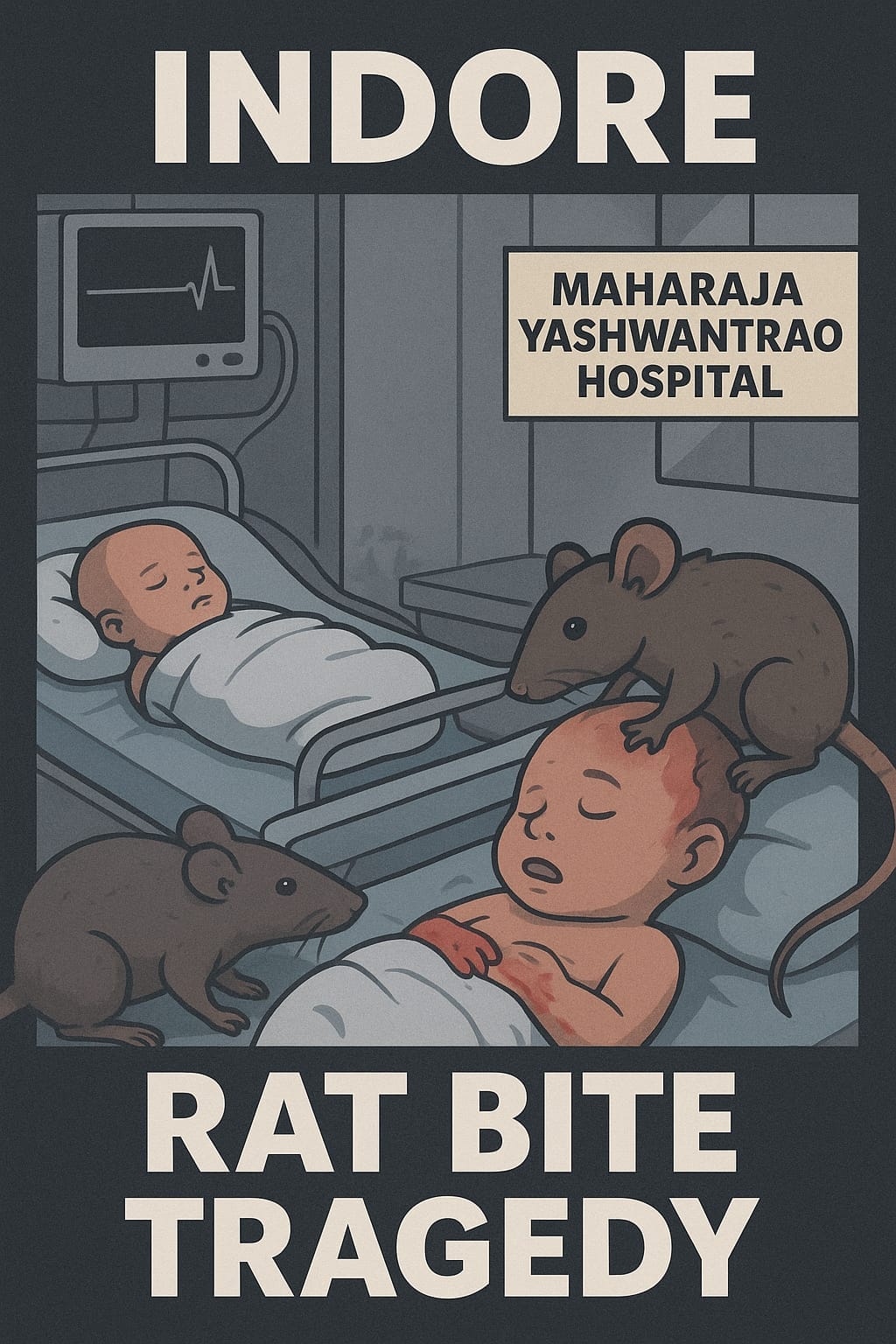
K K Jha
Indore:Two infants, fighting for survival in the Neonatal ICU of Indore’s Maharaja Yashwantrao Hospital (MYH), died earlier this week—not from the congenital complications they were battling, but after rats gnawed at their fragile bodies. The state’s largest government hospital, meant to protect the most vulnerable, became the site of an unspeakable horror. The incident has jolted the nation, not only because of its sheer inhumanity but also because it happened in Indore—the city proudly crowned “India’s cleanest” for eight consecutive years. The tragedy forces a difficult question: what is the value of spotless streets when the very institutions meant to save lives cannot guarantee basic safety?
Beyond outrage: A deeper failure
These infants were already fragile—one abandoned in Khargone, another recovering from surgery in Dewas. Their families trusted MYH, the largest government hospital serving 16 districts, as a lifeline. Instead, they left in grief. The tragedy is more than a local failure. It exposes how institutions collapse when maintenance, vigilance, and accountability slip.
The clean city paradox
Indore has topped the Swachh Survekshan rankings for eight years. Yet rats found free passage into a neonatal ICU. Opposition leaders call it “genocide,” alleging pest control hadn’t been done for years. Authorities contradict themselves—claiming pest control every 15 days, even as the Deputy CM admits it was “irregular.” This paradox—gleaming streets but unsafe hospitals—has turned Indore’s “cleanest city” crown into an uncomfortable symbol of misplaced priorities.
A pattern of negligence
MYH has been here before. In 2016, two children died after nitrous oxide was delivered instead of oxygen in its pediatric ward. That catastrophic error should have transformed hospital safety culture. Yet, less than a decade later, another preventable hazard—rodents—has claimed lives. Across Madhya Pradesh, rodents have attacked patients and even corpses in hospitals from Bhopal to Vidisha and Sagar. The pattern is unmistakable: lessons are not being learned.
Why is this different
Rodents in a mortuary are grotesque, but rodents in an NICU are unforgivable. Nurses reportedly saw rats before the incident but failed to escalate. Pest control contractors were fined after the tragedy, but token measures cannot restore trust. The refusal of a second autopsy adds to suspicions of a cover-up. Public trust erodes not only because of what happened, but because of how evasively it is explained.
What needs to change
NICUs must have sealed ducts, food-free corridors, and real-time rodent monitoring. Pest control should be outcome-based, audited, and strictly enforced. Every “sentinel event” must trigger a root-cause analysis, with findings shared publicly. Administrators, not just contractors or nurses, must be held answerable.
Humanizing the numbers
Behind the statistics were two tiny lives: one abandoned, one post-surgery, both entrusted to the state’s best facility. Their deaths are reminders that public healthcare is not an abstract system but a lifeline for families with nowhere else to go.
The MYH tragedy is not about rats alone. It is about governance that confuses optics with outcomes, a system that forgets its own failures, and a culture that responds only after lives are lost. Indore may remain India’s “cleanest city” on paper, but unless hospitals like MYH become safe, that title will remain a hollow boast.