Indore water tragedy reveals gaps in MP’s Jal Jeevan Mission
3 min read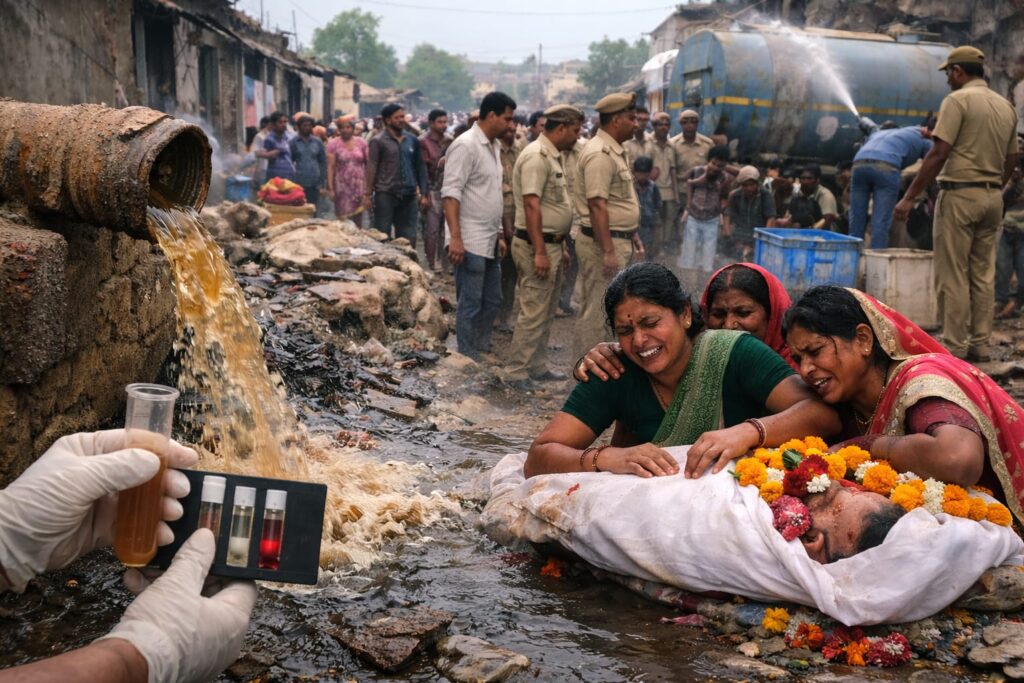
Official alerts on contamination were ignored for years before lives were lost
K K Jha
The tragedy in Indore’s Bhagirathpura area, where contaminated drinking water caused multiple deaths and left hundreds ill, starkly underscores critical failures in Madhya Pradesh’s water governance—contradicting its reputation as India’s “cleanest city.”
At least 16 people have died, and more than 200 have fallen ill after sewage mixed with the municipal water supply in Bhagirathpura, a congested locality dependent almost entirely on piped drinking water. The incident has garnered national and international attention, highlighting the fragile state of urban water infrastructure in the state.
What makes the tragedy particularly disturbing is that official warnings about water contamination in Indore were recorded years before the outbreak.
Ignored warnings, Devastating consequences
What makes this crisis particularly disturbing is that official warnings about contaminated water in Indore were recorded years ago. A 2016–17 Madhya Pradesh Pollution Control Board (PCB) report flagged extensive groundwater contamination in parts of Indore, including Bhagirathpura, with fecal pollution detected at nearly every tested location. Those reports explicitly recommended declaring sources unsafe and posting warnings—but follow‑up action was limited. Residents had complained for months about foul‑smelling, discoloured water, but their concerns were treated as minor maintenance issues rather than urgent threats. The recent deaths have laid bare what many describe as a systemic failure of monitoring, maintenance, and accountability.
Jal Jeevan Mission: Strong numbers, weak safeguards
The Jal Jeevan Mission (JJM), launched by the Government of India to ensure safe and adequate drinking water to every household, has significantly expanded water supply coverage in Madhya Pradesh.
According to the latest official data submitted to the Rajya Sabha on March 10, 2025, Madhya Pradesh has taken up 46,423 drinking water schemes under JJM. As of March 6, 2025, 75.88 lakh rural households—67.86%—have functional household tap connections, compared to just 12.10% in August 2019. The Centre has allocated ₹26,952 crore to the state since 2019–20, of which ₹16,232 crore has been utilized so far.
However, government-linked assessments also reveal a troubling gap between access and safety. A significant proportion of water samples from rural Madhya Pradesh were found unfit for human consumption, and contamination has been reported in over 30 rural locations, indicating that the problem is not confined to Indore alone.
Experts warn that tap connections without consistent water quality testing, pipeline integrity, and treatment safeguards can pose serious public health risks.
Where does Madhya Pradesh stand?
States such as Goa, Haryana, Punjab, and Telangana have combined tap coverage with stronger local monitoring, treatment systems, and transparency in water quality testing. While challenges persist nationwide, large-scale contamination-linked deaths have been relatively rare in these states.
Madhya Pradesh, in contrast, continues to struggle with aging pipelines, sewage intrusion, rapid urban expansion, and weak coordination between civic agencies, particularly in older city areas.
Indore’s case is especially stark, given its repeated top ranking in national cleanliness surveys. The tragedy raises an uncomfortable question: has success in solid waste management masked deeper failures in water and sanitation infrastructure?
Beyond suspensions
Administrative action, including suspensions and compensation announcements, has followed the incident. But public health experts stress that post-tragedy
responses cannot replace preventive milestone.
(The writer is a Senior journalist and political analyst of Madhya Pradesh.)